By Rachel Ohm September 14, 2022
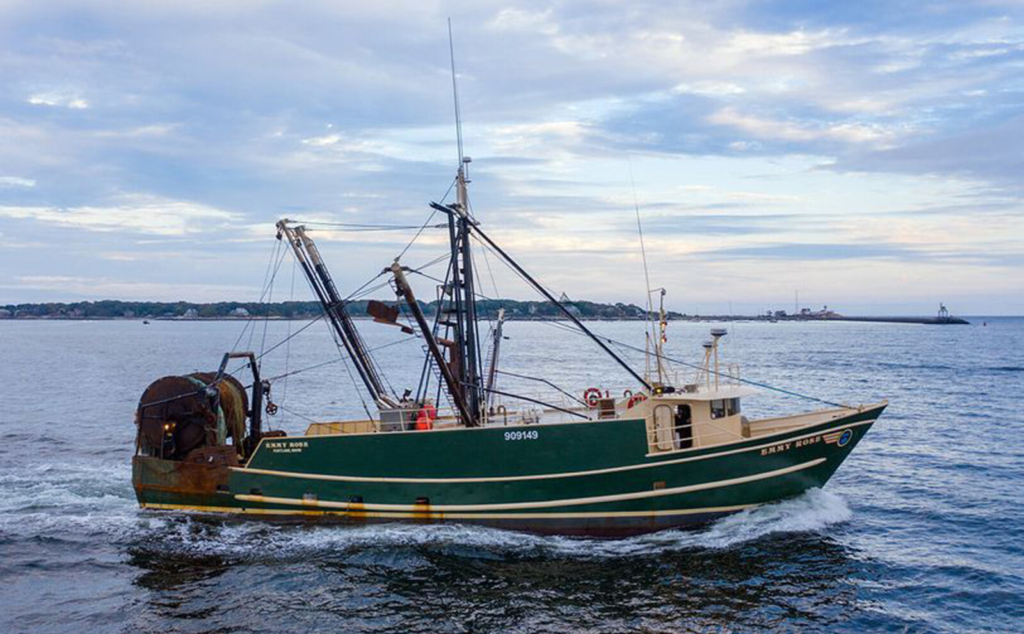
The Emma Rose outbound, Sept. 29. 2020, drone photo from Gloucester Harbor, Massachusetts (Photo by Robert Serbagi)
The Emmy Rose, outbound from Gloucester Harbor in Massachusetts on Sept. 29, 2020. Photo by Robert Serbagi
The sinking of a Portland-based fishing vessel and loss of four crew members in 2020 was likely caused by water flooding through deck hatches that weren’t watertight and didn’t have covers with proper securing mechanisms, according to a new report from federal investigators.
The National Transportation Safety Board also found that two freeing ports, designed to drain water, were closed. That further reduced the Emmy Rose’s stability and caused the vessel to capsize off the coast of Massachusetts in Nov. 2020. The four men on board, three from Maine, were not found and are presumed dead.
In a statement this week, the board said it is recommending that the United States Coast Guard increase the scope of commercial fishing vessel safety examinations to include inspections of a vessel’s freeing port cover design and hatch covers. The board also reiterated an earlier safety recommendation to the Coast Guard to require that all vessel personnel be equipped with personal locator beacons.
That recommendation was issued in 2015 following the sinking of the El Faro, a cargo ship lost at sea near the Bahamas in 2015; and in 2019 after the fishing vessel Scandies Rose sank off the coast of Alaska. All 33 crew members on El Faro died. Five of them – the captain and four crew – were alumni of Maine Maritime Academy in Castine, and four were Mainers. Five of the seven crew members on the Scandies Rose were never found.
“It shouldn’t take three marine tragedies to recognize the vital importance of personal locator beacons,” said NTSB Chair Jennifer Homendy in the board’s statement. “Given their wide availability and relatively low cost, I urge all fishing vessel operators to provide crewmembers with PLBs today – don’t wait for a mandate from the Coast Guard. If the Emmy Rose crew had access to these devices, perhaps some of them would still be with us today.”
After departing Portland on Nov. 17, 2020, the crew members aboard the 82-foot commercial fishing vessel Emmy Rose fished for five days in the Gulf of Maine. On Nov. 22, the captain, Robert Blethen Jr., notified a seafood distribution facility in Gloucester, Mass., that they had assorted groundfish to offload and expected to arrive the following morning.
A crew member told his girlfriend in a phone call that it was the vessel’s biggest catch, and she told investigators that she heard ebullient crewmembers laughing and enjoying themselves in the background.
Hours later, early on Nov. 23, the Coast Guard in Boston received and responded to a distress signal from the vessel. The Coast Guard searched more than 2,200 square miles over a 38-hour period, but the vessel had sunk, according to the NTSB.
Using side scan sonar, the Emmy Rose was located on May 19, 2021, about 3.5 miles west of its last known position, at a depth of 794 feet. A remotely operated vehicle survey, conducted in September 2021, confirmed the location of the wreckage and examined the vessel for visible damage, according to the board’s statement.
The Emmy Rose was more susceptible to capsize because of its design and modifications, the NTSB said. The vessel was originally built for shrimping in the Gulf of Mexico and was modified for fish trawling in New England waters. Its return course toward Gloucester subjected the vessel to winds and seas that likely resulted in seawater accumulating on the rear deck.